How to Talk to Your CFO About AI Gateway Metrics (Without Losing Them in the First Slide) | Kong Inc.
We're Entering the Age of AI Connectivity
Products & Agents:
- Kong AI Gateway
- Kong API Gateway
- Kong Event Gateway
- Kong Metering & Billing
- Kong Insomnia
- Kong Konnect
- Documentation
- Book Demo
May 19, 2026
8 min read
Dan Temkin
Senior Technical Product Marketing Manager, Kong
Your AI infrastructure is producing financial signals your CFO has never seen. Token consumption is a direct cost line item. Cache hit rate is a margin improvement. Model routing decisions are cost arbitrage events. These things are happening right now, in the gateway layer, with no route to the CFO, which means no route to the boardroom.
As the AI connectivity platform owner, you're the person who can build that route. And not because you own the organization's finances, but because you own the system that produces the data.
This is a starter guide for having that conversation with your CFO without losing them in the first 30 seconds of your deck.
Framing the conversation
Success starts with three things to bridge the organizational gap.
The translation table. Guide the CFO through the metrics their infrastructure is already producing and what each one means in financial terms. The goal is not to explain the technology but to establish that infrastructure observability and financial reporting are currently describing the same business in two semantics that don't talk to each other.
One concrete gap. Pick the question with the highest near-term relevance for your business from our samples. Or better yet, articulate one from your organization's current-year business plan. In our conversations, developer consumption of LLM provider tokens or cost exposure in long-running agentic workloads tends to be of high interest.
From the AI connectivity layer, show specifically what data exists, where it lives, and what integrating it into the other systems might require. Concrete is always more useful than comprehensive in a first conversation.A metering proposal. Not a full project plan, but an art of the possible. A clear statement of what instrumentation investment would produce what financial visibility, and what decisions that visibility could support. The CFO's job is to decide whether the investment is worth making. Give them what they need to make that call.
The conversation you're trying to have is not a "please look at all this data we already have" conversation. Instead, you're looking to say: "Our technical control plane is also a financial control plane we don't currently leverage. Here's what it would take to enable it, and here are the decisions it would let us make." That's a conversation any CFO is ready for.
Why this conversation is yours to start
Finance teams aren't equipped to find this problem on their own. They don't have access to the gateway metrics, and even if they did, raw infrastructure data doesn't arrive in a form finance can act on.
What they do know is that AI spending is growing, for most gross margin isn't growing with it, and nobody has given them a model for understanding the relationship between the two.
That's not a finance department problem. It's a data routing and reporting problem. The AI gateway is already capturing everything the CFO needs to understand AI economics at the unit level: what each workload costs, what each customer costs to serve, where cost is being optimized automatically, and where it's running unchecked. The gap is that this data lives in infrastructure observability tooling, not in financial reporting.
When you walk into the CFO conversation, you're not asking for more budget. You're offering them visibility and insight. That's a different conversational dynamic and a much more productive one.
The translation table
Every metric your gateway produces has a financial equivalent. You don't need to teach your CFO what p99 latency is. You need to show them how it maps to profits and losses. These are generic mappings that you can take and better align with your core business.
Check out the quick reference guide for talking to your CFO about AI gateway metrics here.
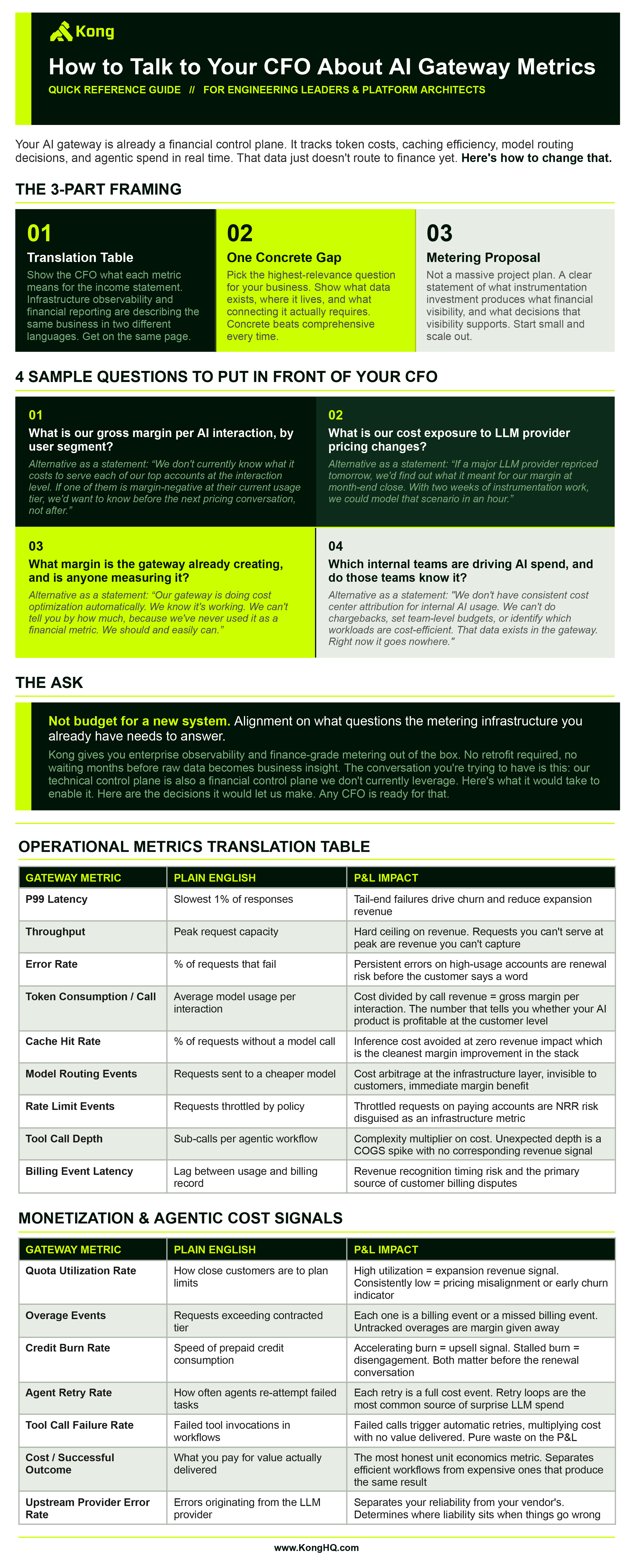
Question options to put in front of your CFO
Question 1: What is our gross margin per AI interaction, by user segment?
Aggregate gross margin can look acceptable while specific user segments or feature workloads run margin-negative. You can't see it in the top-line numbers. You need cost and revenue attribution at the level of individual customers and agentic workloads.
Question 2: What is our cost exposure to LLM provider pricing changes?
Every AI product routing through third-party large language models has direct exposure to repricing by those providers. Most finance teams have no quantified view of this because the token consumption data that would allow it doesn't route to finance.
Question 3: What margin is the gateway already creating, and is anyone measuring it?
Model routing, semantic caching, and request optimization reduce inference costs without changing the user-facing pricing. Most organizations can't quantify it.
Question 4: Do you know which internal teams are driving AI spend, and do these teams also know it?
External customer economics get most of the attention, but internal developer usage is where unattributed AI spend quietly accumulates.
The metering gap is your starting point
The most important technical point to communicate in non-technical terms is this:
Most AI products and platforms have engineering-grade observability. Very few have finance-grade metering: the ability to attribute workloads and cost to serve a specific customer, on a specific workload, compared to what that customer is paying.
At Kong, we 've designed enterprise observability and finance-grade metering into the core of our platform. You already have the right tools. Now is the time to enable them.
Frequently Asked Questions (FAQs): AI Gateway Metrics
1. Why present AI metrics to a CFO in financial terms?
CFOs speak the language of risk, ROI, and cost predictability. Translating AI performance into financial impact shows how your AI initiatives connect to the company's bottom line.
2. What is an AI gateway, and why does it matter to finance teams?
Kong AI Gateway is the management layer between your applications and LLM providers like OpenAI or AWS Bedrock.
3. What is token efficiency, and how does it connect to budget?
Token efficiency means getting the best AI output for the lowest token cost. Improving token efficiency through semantic caching and semantic routing lets your organization handle more queries without a linear increase in LLM spend.